24th Aug 2026
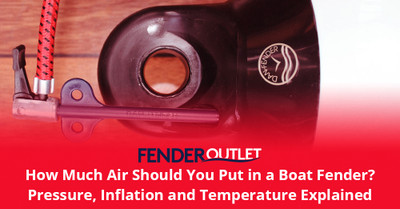
A boat fender should be firm enough to hold its designed shape, yet soft enough to compress under light hand pressure. It should never feel as hard as a car tyre. The correct pressure is set by the manufacturer of the exact model, not by a universal figure for every fender.
As one useful example, Polyform specifies approximately 2.1 psi (0.15 bar) for its inflatable fenders and buoys, while advising compressor users not to exceed 2 psi. Other brands and fabric inflatable fenders can use different procedures, valves and pressures, so always check the product instructions first.
This guide explains what correct inflation looks like, how temperature changes pressure, which tools to use and what to do when a valve leaks. You can find pumps, needles, adapters and replacement parts in our fender inflation range.
Do not guess with a high-pressure compressor. Boat fenders operate at very low pressure compared with tyres. Use a regulated air source, the correct adapter and the manufacturer’s stated pressure or circumference. Overinflation can make a fender less able to absorb impact and may damage its valve, seams or body.
Contents
- Key facts at a glance
- What pressure should a boat fender be?
- Why does fender pressure affect protection?
- What should you check before adding air?
- Which pump, needle or valve adapter should you use?
- How to inflate a boat fender step by step
- How do temperature and sunlight change fender pressure?
- Boat fender inflation troubleshooting
- Can boat fenders be deflated for storage?
- When should you stop inflating and replace the fender?
- Five-minute inflation checklist before berthing
- Frequently asked questions
- Technical references
Key facts at a glance
- Correct inflation is model-specific; read the label, packaging or manufacturer instructions.
- A conventional moulded PVC fender normally needs shape and controlled softness, not tyre-like hardness.
- Pressure is often only a few psi. A powerful compressor can overinflate a fender very quickly.
- Where the manufacturer supplies an inflated diameter or circumference, that measurement can be more useful than an inaccurate low-pressure gauge.
- Air pressure rises as the trapped air warms and falls as it cools. Recheck fenders after major temperature changes.
- Underinflation can let the hull bottom out against the berth; overinflation reduces useful deformation and increases stress on the product.
- Use a blunt manufacturer-approved adapter. Do not force a sharp needle or improvised tool into an unfamiliar valve.
- The valve screw or bung must be seated correctly, but plastic components should not be overtightened.
- Fabric inflatable fenders and moulded PVC fenders are not inflated in exactly the same way.
- Replace a fender that has structural cracks, split rope eyes, failed seams or a valve that cannot be made reliable.
Need the correct inflation fitting?
Valve designs differ between brands. Compare suitable pumps, needles, adapters and replacement bungs before applying air.
What pressure should a boat fender be?
There is no safe single pressure that covers every cylindrical fender, round buoy, dock fender and roll-up fabric fender. The manufacturer may specify pressure in psi or bar, an inflated diameter, a maximum circumference, a hand-compression test or a combination of these.
| Fender type | What to use as the primary target | What correct inflation usually looks like | Important caution |
|---|---|---|---|
| Moulded PVC cylindrical fender | Manufacturer pressure, diameter or circumference | Full shape with no deep creases; sidewall still yields under firm thumb pressure | Do not make it rigid. Confirm the correct valve adapter. |
| Round fender or buoy | Manufacturer pressure and stated circumference | Evenly rounded body without a flattened band or severe distortion | Large products contain a significant volume of air; regulate the compressor and monitor continuously. |
| Fabric inflatable fender | Exact product manual and supplied inflation/deflation procedure | Smooth, supported body with the designed profile | Working pressure and valve system may differ from moulded PVC products. Avoid assuming a Polyform-style figure. |
| Foam or non-inflatable dock fender | No air pressure applies | Material remains resilient and securely fixed | Do not drill, alter or attempt to inflate a product that is not designed for it. |
Many inexpensive gauges are not accurate at the very bottom of their scale. A gauge designed for car tyres may barely move at fender pressure. If the manufacturer provides a circumference chart, measure around the widest or specified section with a flexible tape. Do not exceed that measurement simply because the fender still looks soft.
The existing boat fender size guide helps with diameter and quantity, but choosing the correct physical size does not remove the need to inflate each fender correctly.
Why does fender pressure affect protection?
An inflatable fender protects the hull by deforming and distributing contact load over time and area. Its air and flexible body work together as a spring. Pressure that is far too low or too high changes that behaviour.
| Condition | What happens under load | Likely signs | Possible consequence |
|---|---|---|---|
| Correctly inflated | The body compresses progressively while maintaining separation | Full shape, controlled give and stable contact | Useful energy absorption and a broad contact patch |
| Underinflated | The fender collapses too easily and may flatten completely | Deep wrinkles, sagging, excessive softness or loss of diameter | The hull can reach the pontoon, pile or adjacent boat; the fender may roll or pinch. |
| Overinflated | The body has little initial compliance and local stress rises | Very hard feel, stretched appearance or valve/body distortion | Reduced cushioning, increased bounce and premature damage to the valve, seams or rope eyes. |
| Wrong position | Even a correctly inflated fender is pushed away from the contact point | Fender rides onto the pontoon or escapes fore/aft | Direct hull contact despite correct pressure. |
Pressure is only one part of the system. Fender diameter, quantity, hull shape, attachment height and berth movement remain equally important. Review our guide to attaching boat fenders if a well-inflated fender still rolls out of position.
What should you check before adding air?
- Identify the exact brand and model. Look for a moulded name, label, product code or original packaging.
- Find the approved inflation method. Confirm pressure, circumference, adapter and valve procedure.
- Inspect the body. Do not inflate a fender with deep cracks, cuts, exposed reinforcement, split seams or badly damaged rope eyes.
- Clean around the valve. Sand and grit can damage seals or be pushed into the mechanism.
- Choose a controlled air source. A hand or foot pump gives more time to assess shape. A compressor must have accurate low-pressure control.
- Warm a cold, stiff product naturally. Follow the manufacturer’s advice; never use a naked flame, heat gun or boiling water.
- Measure the current shape. If the body has already expanded fully, apparent softness may not mean it needs more air.
Never hold a fender in front of your face while using compressed air. Position it securely, keep people clear, add air in short controlled bursts and stop immediately if the body, valve or rope eye changes shape unexpectedly.
Which pump, needle or valve adapter should you use?
Boat-fender valves are not standardised across every manufacturer. Common arrangements include screw-plug valves with a non-return flap, football-style valves, removable bungs and high-flow fabric-fender valves. The adapter must match the product rather than merely fit into the opening.
| Tool | Best use | Advantages | Risks or limitations |
|---|---|---|---|
| Hand pump | Routine top-ups and small to medium fenders | Slow, controllable and portable | Can be tiring with very large round or fabric fenders. |
| Foot pump | Moderate-volume inflation on board | Stable operation and useful control | Hose and adapter must be secured; some gauges are inaccurate at low pressure. |
| Regulated compressor | Large fenders or workshop use | Fast and convenient | Can overinflate within seconds. Use low-pressure regulation and stay beside the product. |
| Tapered nozzle or brand adapter | Manufacturer-specific screw/flap valves | Opens the valve correctly without puncturing it | The wrong diameter can damage the valve seat or become stuck. |
| Pump needle | Only valves designed for a needle | Compact and inexpensive | A sharp or incorrect needle can puncture the valve or body. Never improvise. |
Browse our fender pumps and valve adapters by checking the product description against your fender brand. When the valve type is unclear, send photographs of the fender, valve and any markings through our contact page before forcing a fitting.
How to inflate a boat fender step by step
- Read the instructions. Record the maximum pressure, diameter or circumference and identify which plug or screw must be removed.
- Place the fender on a clean surface. Keep it away from sharp metal, gravel and hot exhausts.
- Remove the cap carefully. Use hand tools only where the manufacturer specifies them. Keep small plastic parts safe.
- Insert the correct adapter. It should operate the non-return valve without excessive force.
- Add air slowly. Pause frequently to rotate the fender and check that it is expanding evenly.
- Check pressure and shape. Use the correct low-range gauge, circumference chart or hand-deflection test.
- Stop at the specified limit. Do not add “a little extra” for rough weather; use larger or additional fenders instead.
- Remove the adapter and reseal the valve. Tighten a plastic screw only until it is correctly seated or flush as instructed.
- Listen and test. Apply a mild soapy-water solution around the valve if permitted; growing bubbles indicate leakage. Rinse afterwards.
- Recheck after use. Confirm the fender has not stretched, softened rapidly or developed a distorted rope eye.
Large round fenders and high-volume inflatable fenders may take longer than expected. Speed is not a reason to bypass the stated maximum pressure.
How do temperature and sunlight change fender pressure?
Air expands as it warms. A fender inflated in a cold shed can become noticeably firmer when moved into strong sun; a fender inflated on a hot afternoon can feel softer after a cold night. The change is most obvious where the product is already near its maximum shape.
- Cold-to-hot move: check the product before leaving it in direct sun or a hot vehicle. Release air only in accordance with the valve instructions.
- Hot-to-cold move: do not automatically top up the moment it feels softer. Consider where and at what temperature it will be used.
- Seasonal storage: avoid storing a fully pressurised product beside heaters, in roof spaces with extreme heat or in direct sunlight.
- Dark colours: may become warmer in sunlight than pale colours; the relevant issue is the actual product temperature and pressure, not colour alone.
- Long passages: inspect fenders after moving between climates, especially before a demanding berth or rafting situation.
Do not compensate for an exposed berth by overinflating. Use the right fender size, more fenders, suitable shapes, correct lines and berth-specific positioning. An overinflated small fender does not become a heavy-duty fender.
Boat fender inflation troubleshooting
| Problem | Likely causes | What to do |
|---|---|---|
| Air will not enter | Wrong adapter; non-return flap stuck; blocked valve; product already at full size | Stop forcing the fitting. Confirm the manual. Use only the specified blunt method to open a stuck flap. |
| Air escapes as soon as the pump is removed | Non-return valve not sealing; dirt; missing or damaged plug | Clean externally, reseat the approved cap and test. Replace the valve component where the design permits. |
| Slow leak over days | Loose screw, perished seal, pinhole, split seam or temperature change | Test at a stable temperature. Use soapy water if allowed and inspect the entire body. Do not rely on repeated topping-up for a structural fault. |
| One side bulges | Uneven wall stretch, internal damage, overheating or overinflation | Deflate safely and remove from service. Seek manufacturer or retailer advice. |
| Rope eye stretches or cracks | Line too thin, overload, UV degradation or overinflation | Replace the fender if structural integrity is affected and review line diameter and attachment. |
| Valve screw will not sit flush | Cross-threading, debris or damaged threads | Do not drive it with a power tool. Remove pressure, clean and inspect; replace the part or fender if it cannot seal. |
A fender that repeatedly loses air during a single berthing session should be treated as unreliable. Move another sound fender to the contact area and replace or professionally assess the leaking unit.
Can boat fenders be deflated for storage?
Some boat fenders are designed for routine deflation; others can technically be deflated but are more convenient to store at normal shape. Fabric inflatable fenders are specifically intended to be rolled or packed after the air is removed, whereas traditional moulded fenders are often kept inflated in a locker or fender basket.
- Use only the manufacturer’s deflation method and a blunt approved tool where a non-return flap must be held open.
- Do not pierce the valve or remove a permanently fitted valve body.
- Do not fold a moulded PVC fender sharply; creasing can damage the material or make reinflation uneven.
- Dry fabric inflatable fenders before rolling them to reduce odour and mildew.
- Replace the cap or screw after deflation so dirt and insects cannot enter the valve.
- Store the adapter with the fender and label it by brand or model.
For a broader maintenance routine, see how to clean boat fenders. Cleaning before deflation prevents grit being rolled against the surface.
When should you stop inflating and replace the fender?
Inflation cannot repair aged material or structural damage. Retire the fender from critical use when you find:
- a split, deep cut or exposed inner layer
- cracks radiating from a rope eye or valve
- a seam opening on a fabric inflatable fender
- permanent bulging or an uneven body shape
- a valve that cannot hold pressure after correct cleaning and sealing
- severe hardening, brittleness or sticky surface degradation
- a repair that is not approved for the product and intended load
- repeated rapid pressure loss without an identifiable serviceable component
Compare replacement sizes using the Fender Outlet size guides, then choose from cylindrical boat fenders or round boat fenders according to the boat and berth.
Five-minute inflation checklist before berthing
- Correct fenders selected for the boat, contact height and conditions
- Bodies fully shaped but not rigid
- No cuts, bulges, split seams or damaged rope eyes
- Valve plugs present, clean and correctly seated
- Fender lines thick enough for the rope eye and free from chafe
- At least one spare fender ready for an unexpected berth or raft-up
- Pressure rechecked after a major temperature change
- Inflation adapter and compact pump stored where they can be reached
Frequently asked questions
Should a boat fender feel hard?
No. A conventional inflatable fender should hold its designed shape but retain controlled give. A rock-hard fender may be overinflated. Use the exact manufacturer pressure or size specification rather than feel alone.
Is 2 psi correct for every boat fender?
No. Polyform specifies about 2.1 psi/0.15 bar for its products and advises compressor users not to exceed 2 psi, but other brands and fabric fenders may differ. Check the exact model instructions.
Can I use a bicycle pump to inflate a boat fender?
Often yes, provided you have the correct valve adapter and can monitor the low pressure or target circumference. The pump’s standard tyre connector may not fit the fender directly.
Can I use an air compressor?
A regulated compressor can be used where the manufacturer permits it, but it can overinflate a low-pressure fender very quickly. Set an appropriate limit, add air in short bursts and never leave the product unattended.
Why does my fender feel softer in winter?
Air pressure falls as temperature drops. Inspect for leaks, but also compare the temperature at which the fender was last inflated. Do not exceed the specified pressure merely to make a cold product feel hard.
How can I tell whether a valve is leaking?
At a stable temperature, listen for escaping air and, where the manufacturer permits, apply a small amount of mild soapy water around the valve. Growing bubbles indicate leakage. Rinse and dry the area afterwards.
Can a punctured boat fender be repaired?
Repairability depends on material, location and manufacturer approval. A patch that works on a roll-up fabric fender may be unsuitable for a moulded PVC fender or damaged rope eye. Do not trust an unapproved repair in a critical berth.
Should I deflate fenders over winter?
Only where the design and storage plan make it useful. Fabric inflatable fenders are intended for compact deflation. Many moulded PVC fenders are best cleaned, dried and stored at normal shape away from heat and direct sunlight.
Technical references
Manufacturer specifications, product instructions and local berth conditions always take priority over generic guidance. Check the instructions supplied with the exact fender, buoy, holder or fitting before use.